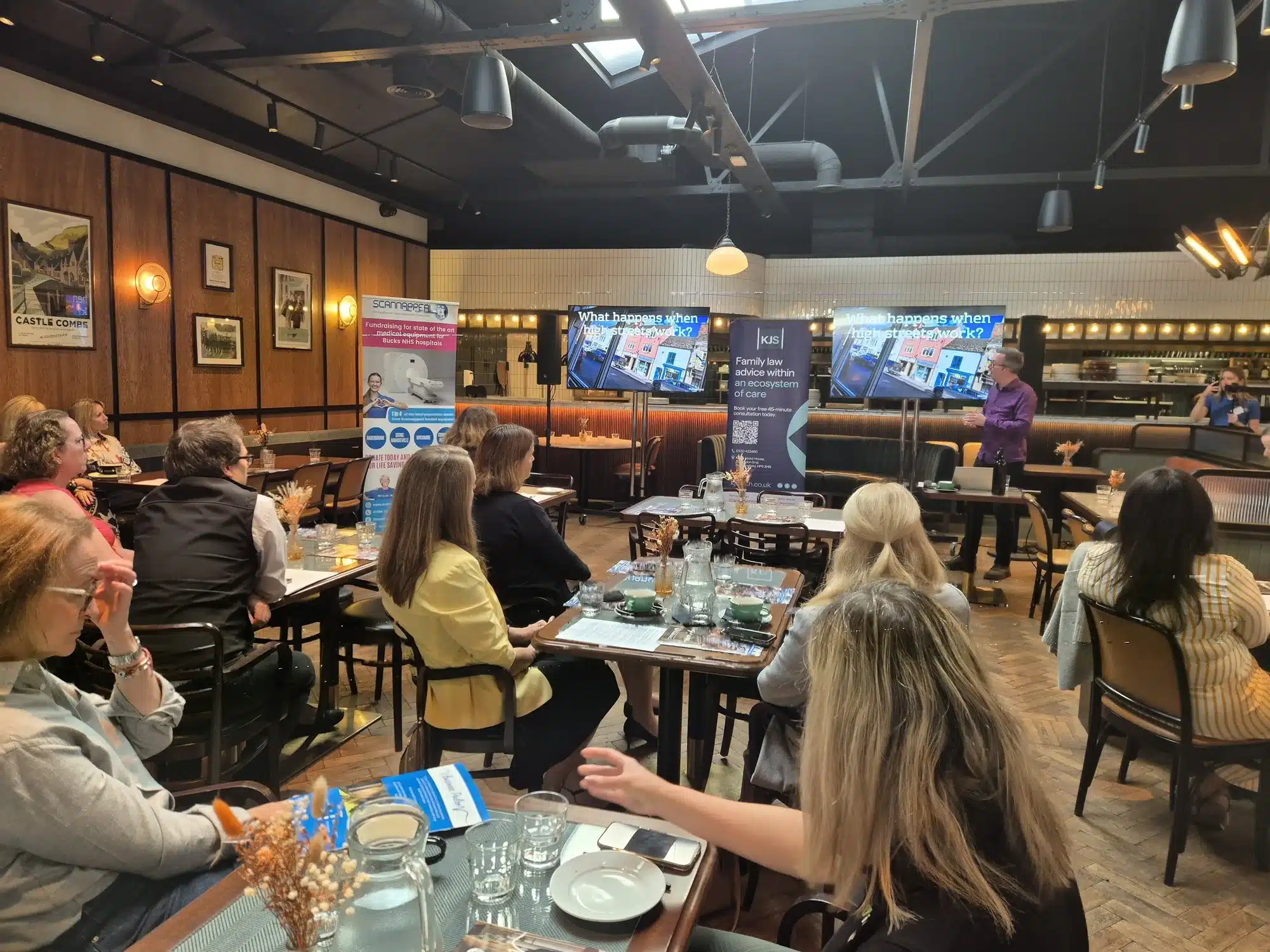
This morning I sat in The Journeyman on Packhorse Road in Gerrards Cross and listened to a retail consultant from Gateshead explain why the story a town tells about itself matters almost as much as what’s actually on its streets. The event was a Scannappeal business breakfast, the Buckinghamshire healthcare charity’s speaker series for local business. The speaker was Graham Soult of Canny Insights, a Fellow of the Institute of Place Management who has spent fifteen years walking UK high streets. Two officers from Buckinghamshire Council’s Economy, Investment and Regeneration service, Donna Wilkinson and Jacqueline Ford, responded.
I went because I care about Aylesbury’s town centre. We’re based on Market Square and we walk through it every day. I also went because most of what we do at Proud Brands is high street thinking applied to the internet, and I wanted to see how far the parallel held. It held further than I expected.
The question Graham asked
Graham opened with the point that every time high streets make the news, the conversation is about what’s wrong. A shop has closed. A vape shop has opened. A chain has gone. People shop online. “We’ve become very good at diagnosing what’s wrong with our high streets,” he said, “and we don’t need to keep repeating that over and over again.”
He wanted to ask a different question. What happens when high streets work?
His answer wasn’t full occupancy, and it wasn’t 1995 recreated. It was places that are busy, where interesting businesses want to invest and people want to spend time. He showed Nuneaton, surprisingly busy on a random weekday with the old Debenhams being redeveloped. Rugby, with pockets of lovely streetscape. Dunstable. Galashiels in the Scottish Borders, where he’s been working this summer. Stroud, where an old Woolworths is now a medical practice. None of them perfect, all of them working.
His line on this was blunt. “A successful high street in 2026 doesn’t have to look like a successful high street in 1996.” And what works in one town doesn’t transplant to another. Sunderland’s momentum, he said, is not a template for Middlesbrough. The council would make the same point about Marlow and Aylesbury an hour later.
The old formula was retail on long leases, packed by day and dead after hours. What replaces it is a mix. Hospitality, gyms, beauty, healthcare, education, people living above the shops with the lights on after six. He told the story of Borders Podiatry in Galashiels, a clinic trading from a former Carphone Warehouse with over 500 appointments a month and a waiting list running months ahead. Those patients arrive early, stay for a coffee, and walk past every other business on Channel Street. A podiatrist is a footfall driver. “You can’t meet a friend for coffee on Amazon,” he said, and the room laughed, because it’s true.
Seven things a town can influence
Graham was clear about what a town can’t control. The global economy. Energy prices. The cost of living. Business rates, which no government has yet reformed. “It’s very easy to become overwhelmed by all the things that are outside our control,” he said. So he asks what can be influenced locally, and he’s boiled it down to seven ingredients he calls REVAMP.
Relationships. The places that work are the ones where the council, the landlords, the traders and the wider business community know each other and pull the same way. He ran a workshop in Malmesbury in Wiltshire, a well-off town that still felt it could do more. People started a WhatsApp group. A retailer took the chair of the town team. A year later the town centre was reported at full occupancy.
Events. A reason to be there that has nothing to do with buying something.
Vacancy. An empty shop is a problem and an opportunity at the same time. Graham runs a service he calls Retail Cupid, matching people who want premises with units that are actually available. Emma emailed him four years ago wanting to open a bookshop in Durham. She’s just celebrated four years of trading and taken a second floor.
Arrival. His name for what he called the boring stuff. Can I get there. Do I know where I’m going. Is it clean. Is there somewhere to sit. Can I find a loo. Do I feel safe.
Mixed uses. The podiatrist, the gym in the old Argos, the student flats above the former Topshop.
Positivity. This is the one he’s most passionate about, and it’s where he got animated. “If residents repeatedly hear that their town centre is dying, why would they choose to visit it?” Investors hear the same story and draw the same conclusion. “No business has ever said to me, Graham, it would really help my business if more people thought our high street was dead.”
Support. Plenty of people want to open a shop and don’t know where to start. Which units are actually available, who owns them, what the rent should be, whether they’re about to make a terrible mistake. “Sometimes what unlocks an empty shop isn’t a big regeneration programme,” he said. “It can be as simple as somebody saying, let me introduce you.”
He wasn’t offering it as a formula. He said if there were a formula he’d be earning a lot more. These are the seven things that keep turning up in the towns that work, and every one of them is within reach of the people who live there.
What the council said
Donna and Jacqueline hadn’t come to argue. Jacqueline said her three reflections were that different towns need different expressions of the same ingredients, that the council can lead and convene but every business can contribute, and one line that I wrote down word for word.
“Physical change is not enough. People need to notice it, they need to experience it, and update the story that they tell about their place.”
She backed it with data. The council walks the county’s town centres every quarter and records what has opened and closed. Vacancy in Buckinghamshire is lower now than it was through Covid. “But you wouldn’t think so,” she said, “the way that it’s reported.” A shop that looks empty is often already let and waiting on planning or a fit-out. The reality has moved. The story hasn’t caught up.
Donna talked about the High Street Support Programme the council commissioned from Retail Revival with Shared Prosperity money, which began by asking the businesses what they needed rather than telling them. This summer it funded ten business-led events across the county’s high streets, each one built around something that town is known for, with the stated aim of getting people to look past the two or three shops they always use. The council has said it will keep the programme running into 2026/27 even though the national funding has ended.
Jacqueline closed with a question for every business in the room. What is one small practical thing your business could do to strengthen your town, and who could you do it with?
The three questions Graham asks a shopfront
Here’s where it got interesting for me. When Graham wrote up his Galashiels business workshops last month, he described the three questions that frame them.
Could a first-time customer find your business? Would they understand why it’s worth visiting? Would they feel confident enough to walk through the door?
He was talking about shopfronts, window displays, signage, Google Business Profiles and social media. He was also describing, almost word for word, the method we’ve run at Proud Brands since long before AI search made it fashionable.
The same questions, asked of a website
OSOF® is how we think about a business’s presence online, and it has four pillars: Visibility, Clarity, Trust, Conversion. Set them beside Graham’s questions and beside his seven ingredients and they line up without forcing.
Visibility is Arrival. Can a buyer get to you, and do they know where they’re going. On a high street that’s signage and a clean approach. Online it’s whether you appear when someone in Aylesbury searches for what you sell, and whether the listing tells them you’re open. A business that doesn’t show up for its own trade in its own town has the lights off, however good the work inside.
Clarity is the shopfront. Graham complimented the Galashiels podiatrist for animating her window with socks and flip-flops, so that a passer-by understood what the place was for. Online that’s the page that says plainly what you do, for whom, and why it’s worth the visit. Most business websites fail here, not on design. They look fine and say nothing.
Trust is Positivity and Relationships together. It’s the story people tell about you, and Jacqueline’s warning applies exactly. The lag between what a business has become and what its reputation says about it is where most local enquiries are lost. Reviews, named clients, real results, being talked about by people who aren’t you.
Conversion is walking through the door. Graham didn’t name it separately because in retail it’s obvious. Online it’s the enquiry, the booking, the call, and it’s the number that tells you whether the first three are working.
The two frameworks do different jobs and I won’t pretend Events or Mixed uses map onto a website. But the discipline is the same. Ignore the things you can’t control and work the things you can.
I can say that with some confidence because we’re in the middle of doing both at once. On a neighbourhood parade in Aylesbury there’s an independent grill and chip shop that has quietly become a Turkish restaurant. The grill is most of the takings now and growing. There’s mezze and there are desserts. None of that is on the sign, or the printed menu, or the Google listing, so a first-time customer sees a chippy and walks past a restaurant. The job we’ve taken on covers the frontage, the signage, the interior and the online presence as one piece of work, because the customer meets the business in both places and the two stories have to match. That is Graham’s Arrival and Clarity done with paint and vinyl, and Jacqueline’s “people need to notice it” done with a listing and a review strategy. I’ll write about what happens to the takings when it’s finished.
A shop with the lights off
I’ll own our own example, because we’ve published it. Before we rebuilt our site this summer, the search that matters most to a local agency, “seo aylesbury”, was producing 11,000 impressions at position 20 and zero clicks. Eleven thousand people walked past the shop and not one came in. We were the SEO agency that had never done its own SEO, and Graham’s point about diagnosis applied to us as much as to any town. We knew exactly what was wrong. We just hadn’t done the boring Arrival work.
We relaunched on 31 July 2026. In a read taken seven weeks after, first-page buyer searches with meaningful exposure: from 10 to 93. Physical change, then noticing. It’s early and I’ll keep publishing the numbers whichever way they go.
Radley Windows & Doors is the client version of Jacqueline’s story. A firm known locally for years and invisible to anyone who didn’t already know the name. The numbers on the case study are −34% mobile position, −30% desktop position, +6% clicks and 188K impressions. Nathan Ing put the outcome better than I could. The point was to “…reach the customers who didn’t know our name yet.”
Coffee Lady is the version where the shopfront gets rebuilt around how commercial buyers actually search. The headline there is +229% clicks. Same ingredients, different town.
What one business can do
Jacqueline’s list of small things was practical. Hold your meetings in an independent cafe. Use a local supplier. Sponsor something. Include local businesses in staff benefits. Recommend the town to your clients. Graham’s version was a turn on an old line. “Don’t just ask what your high street can do for your business. Ask what your business can do for your high street.”
So here’s ours. We’ll keep taking on the businesses that are changing what a Buckinghamshire high street is, and we’ll do the shopfront and the search results together rather than pretending they’re separate jobs. We’ll hold our meetings in the places we work on. And we’ll publish what happens, numbers included, the way we’re already doing for our own site. The bookshop in Durham and the podiatrist in Galashiels got written up because somebody noticed. Businesses in Aylesbury deserve the same.
If you run a business in Aylesbury, or anywhere in Buckinghamshire, and you suspect you’re the shop with the lights off online, the fix starts the way Graham’s does, with local search treated as part of the shopfront. Someone walks the street with you and tells you what a first-time customer sees. We do that for Aylesbury businesses and across the county, and the first conversation costs nothing. Get in touch and tell us what’s not working.
Questions answered
What did Graham Soult mean by "what happens when high streets work"?
He was asking people to stop diagnosing decline and study the towns that are busy, attracting investment and giving people reasons to spend time there. His examples included Nuneaton, Rugby, Dunstable, Galashiels and Stroud. None are fully occupied or problem-free. All are working, and none looks like a high street from the 1990s.
What are the seven ingredients in Graham Soult's REVAMP framework?
Relationships, Events, Vacancy, Arrival, Mixed uses, Positivity and Support. He presents them not as a formula but as the seven things that keep appearing in successful town centres, chosen because every one of them can be influenced locally, unlike the economy, energy prices, the cost of living or business rates.
How does a high street's health relate to a business's online visibility?
The same questions apply. Graham asks whether a first-time customer could find a business, understand why it's worth visiting and feel confident enough to walk in. Online those are Visibility, Clarity and Trust, and the enquiry is Conversion. A business that doesn't appear for its own trade in its own town has the lights off.
What support is there for high street businesses in Buckinghamshire?
Buckinghamshire Council runs a High Street Support Programme delivered by Retail Revival, offering one-to-one action planning, webinars, events and business improvement grants for independent high street businesses. The council has said the programme will continue into 2026/27. Details are on the council's business support pages.
Sources
- Scannappeal, Scannappeal Business Breakfast, 22 September 2026, The Journeyman, Gerrards Cross. Talk by Graham Soult, "What Happens When High Streets Work?", with responses from Donna Wilkinson and Jacqueline Ford, Buckinghamshire Council.
- Canny Insights, Championing UK retail and high streets and Seven Galashiels businesses and the positive stories behind the shopfronts, 27 August 2026. The three workshop questions and the Borders Podiatry appointment figure are as Graham published them.
- Buckinghamshire Council, Supporting local business (UK Shared Prosperity Fund) and Buckinghamshire Council stages High Streets Convention, 2026.
- Proud Brands, own Google Search Console data: sixteen months to 30 June 2026 and a 28-day read taken 18 September 2026, as published in our self-run write-ups.
- Proud Brands case studies: Radley Windows & Doors and Coffee Lady.